Posts

Infinite Information (Podcast) - Episode 2

Image
  Powered by RedCircle

Interstellar Objects

Image
The vast majority of space is empty. However, gravitationally clusters of objects can form. For instance, the main asteroid and Keiper belts are clusters of objects that orbit the inner and outer solar system respectively. The objects that exist within these belts range from small microscopic ices to large macroscopic chunks. Due to its size and mass, everything contained within our solar system is gravitationally bound to the sun. The gravitational field associated with small or large object interact with the sun to form a stable circular orbit. In accordance with Newtonian mechanics this effect is more prominent with larger planetary objects then that of smaller particle sized objects. This gravitational attraction from the sun is large, but not infinite. At distances of up to 3.2 light years from the sun the gravitational bind is no longer felt. At these distances a final layer of objects are located and surround our star. This is called the Oort cloud: Much like Earth, the Oort cl...

The Wow! Signal

Image
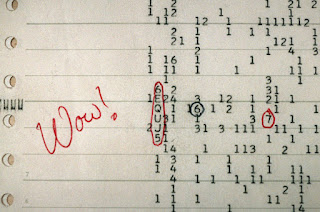
My last post entitled " SETI@home " discussed BLC1, a potential candidate for a signal originating from extra-terrestrial intelligence. However, this is not the only signal Earth has received that may have originated from extra-terrestrial intelligence. A classic example is known as the "Wow! signal". The 70s saw the birth of globalisation and as a result a brief fling with the punk/hard rock counterculture movement. Indeed, terrestrial airwaves were busy with the radio signals of either global mainstream news, Sex pistols, Joan Jett and of course my personal favourite AC/DC. However, during this infamous decade Ohio state University began conducting its first continuous SETI program with the hope of finding evidence of extra-terrestrial life.   On the 15 th of August 1977 the Ohio state University telescope "Big Ear" detected a strong radio signal emanating from the Sagittarius constellation. This signal was noticed days later by volunteer astronomer Jer...

SETI@home

Image
The 1990’s was a decade of PlayStations, Britpop culture and the rise of internet activity. However, whilst I was struggling getting to grips with Lara Croft (tomb raiding of course) and listening to Blur, SETI (searching for extra-terrestrial intelligence) launched an online project called SETI@home in 1999. This meant home computer users could download raw telescopic data and transform this into something meaningful, perhaps an alien transmission? Over the years spurious candidate signals have been detected and out ruled as background terrestrial interference and dead ends.  SETI@home now operates under a larger umbrella called ‘ breakthrough listen ’ as a part of the wider ‘ breakthrough initiatives ’ project. Most recently, users finally detected a signal which serves as our first signal candidate in almost 22 years of searching and listening. This is referred to as BLC1 (breakthrough listen candidate-1) and has scientists baffled for answers.  The first baffling aspe...

Reflections on Life

Image
A physical mirror reflects an exact copy of ourselves. However, in a cosmological mirror, things may not be what they seem. Do we have a cosmological reflection? Would it be a good idea to physically meet them? What makes them and us unique? The Reality of Chirality: The concept of multiple universes existing parallel to the one we live in is an attractive idea. Whilst the possibilities are endless and perhaps complex. Consider for now the possibility of there being just one simple universe, a perfectly reflected mirror universe. To begin with we must consider the properties of reflective symmetry. If an object is not symmetrical its mirror image is non-superimposable, as one cannot be perfectly overlapped onto the other, this means the object possesses handedness and is therefore chiral. The term chiral stems from the ancient Greek word ‘ kheir ’ meaning hand. A pair of human hands are mirror images, yet non-superimposable, they are therefore chiral. Lets now consider chira...

Life on Venus?

Image
One of life's greatest mysteries is that are we alone? For a while it was speculated that the best chances of finding some form of life within our tantalising close solar system would have been on Titan (one of Saturn's many moons). However, very recently scientists have uncovered evidence to suggest that life may exist on Venus!  This is an incredibly ground breaking result. Life on the baron hot rock of Venus, surely not? Whilst the surface of Venus is simply too hot to harness some form of organic life (such as ourselves). The upper atmosphere of Venus produces clement conditions for perhaps life to flourish... Surface and atmospheric temperatures of Venus The surface temperature of Venus is 464°C, this is simply too hot for organic life. However, around 50 miles from the surface the upper and lower gas clouds produce temperatures between 30°C and 80°C, indeed a more clement temperature.   A 2019 survey of Venusian light absorbances suggested the presence of chemica...

Network: Galactic

Image
Intergalactic space travel seems exiting doesn't it? However, the reality is that even with current or futuristic technology intergalactic travel would take a very long time. Galaxies within our local group are millions and billions of light years away, meaning it would take millions and billions of years to reach them if we travelled at the speed of light. Galaxies outside our local group are not gravitationally bound to our own group, this means they will continue to accelerate away from us, in essence we would forever travel into 'nothing' trying to reach them. However, what if there was an easier way? In 1916 Einstein 's theory of general relativity boldly predicted the existence of black holes. Whilst scoffed at by many at the time, he was later proved correct! General relativity also predicted the existence of wormholes! Lets suspend disbelief for a moment and assume the following: 1: String theory is proven correct and strings existed primordially. 2: Black holes...

Boring Boron? 2

Image
In Boring Boron , I discussed the formation of the two main isotopes of boron, now lets talk about boron's chemistry. Upon production of boron via cosmic nucleosynthesis in Earths atmosphere, boron descends to Earths surface and over time crystallises as a mineral. Elemental boron cannot be isolated naturally, instead it is extracted in the form of a rock mineral called borax. Borax contains an oxide form of boron which crystallises as a sodium salt, this is called a borate compound. The two main types found naturally are borax and kernite: Figure 1: Two forms of borate isolated naturally, a) borax and b) kernite. The depicted structures are isolated ion pairs, inside the rock mineral these polymerise via the hydroxy (OH) groups. Kernite exists as the dehydrated form of borax. Borax and kernite are incredibly useful. Commercially they can be used as a pesticide and a fungicide for crops on large scales. They are also used as a metal fusing agent during welding processes. This is be...

Newton

Image
In 1666 the 'great plague' epidemic brought havoc to London and as a result effective 'lockdown' restrictions were introduced. In greater London, the University of Cambridge closed as a precaution. However, an infamous student of the university at the time returned to his home in Lincolnshire and continued his study. His name was Isaac Newton and during this epidemic he was about to make scientific history... During 1666 Newton began to work on ground breaking (at the time) science and mathematics. These were gravitation, calculus and optics:  Figure 1: Newtons work on gravitation started in 1666, a) planetary gravitation and b) local gravitation. Newton pondered the motion of the moon around the Earth and believed some invisible force was responsible. The story goes that whilst sitting underneath a tree an apple fell and bounced of his head. This got Newton thinking, perhaps the same force operates on both small local levels and large planetary levels? Thus the very si...

Boring Boron?

Image
‘Boring Boron’ is an unfortunate phrase that I have become all too familiar with throughout my undergraduate and postgraduate study. This alliterative slogan has a ring to it that needs addressing. Recently I wrote an article regarding this topic and I intend to write more in a series. However, rather than wait for publication here is just one reason of many as to why boron isn’t boring. The birth of boron is certainly not boring. Usually light elements such as hydrogen and helium are produced under the extremely dense and hot conditions of primordial nucleosynthesis during the early universe. Heavier elements such as nitrogen and oxygen are produced under the similar conditions of stellar nucleosynthesis. In both processes’ fusion occurs to produce nuclei, these nuclei are comprised on protons and neutrons (fundamental building blocks). Figure  1 : Stellar nucleosynthesis pathways, a) neutron capture and b) alpha process, protons are in purple and neutrons in brown. Oxygen-...

Cosmic Microwave Background Radiation

Image
When I was younger, in order to receive and interpret radio wave signals as pictorial and audient information analogue television required tuning in. My grandad tried to explain to me that the static fuzz of black and white pixels was an untuned television trying to interpret the universes oldest radiation. I was too young at the time to understand what he meant. Now I have come to appreciate this as the cosmic microwave background radiation (CMBR): The CMBR data interpreted as a universal heat map in the sky What it is it? Predicted to exist in the 1940’s and discovered in the 1960’s, the CMBR is currently the oldest existing radiation in our universe, it is everywhere. The radiation waves are millimetres in length and thus relatively long in the electromagnetic spectrum, they cannot be seen to the naked eye. The image you see above was recorded by the Planck telescope and the associated data was released in 2006. Careful analysis was required in order to remove other wavelengths of ...